Education is often presented as a neutral space, where educators are expected to avoid “politics” and focus narrowly on curriculum delivery. Yet this idea of neutrality is increasingly untenable. In classrooms shaped by racialised inequality, global conflict, online misinformation and the rise of far-right narratives, silence does not protect young people — it communicates values.
Choosing not to address racism, dehumanisation or injustice does not make these issues disappear; it leaves learners to make sense of them alone, often through the most harmful voices online. Far from being a neutral stance, retreating from difficult conversations frequently reinforces the status quo and legitimises harm. If education is to play a meaningful role in fostering peace, dignity and democratic life, educators must be supported to move beyond false neutrality and engage critically, ethically and courageously with the realities shaping learners’ lives.
Educators for Peace
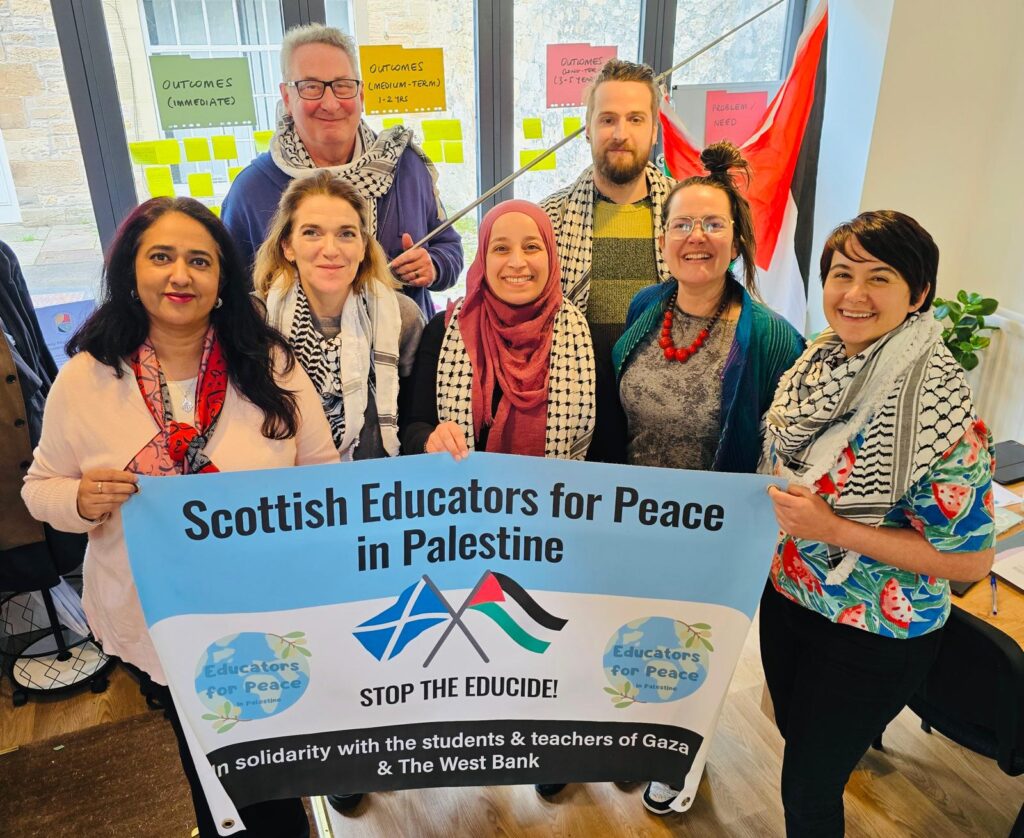
Since its launch in August 2025, the Educators for Peace association has grown from a shared concern into a collective response to one of the defining challenges facing education today: the normalisation of racism, far-right narratives and political intimidation, and the persistent expectation that educators should remain “neutral” in the face of injustice.
Educators for Peace brings together educators from across early years, schools, further and higher education, community learning and teacher education. The association is intentionally diverse, intersectional and cross-sector, grounded in a shared commitment to peace education, anti-racist practice and critical engagement. Rather than positioning peace as silence or avoidance, we define peace as the presence of justice, dignity and solidarity.
Peace is the presence of justice, dignity and solidarity
Over the past year, the association has focused on creating spaces where educators can think, learn and act collectively. Three professional learning webinars have formed the backbone of this work, reaching over 200 educators across Scotland. These sessions addressed pressing issues including responding to far-right rhetoric with anti-racist education, building courageous classrooms, and understanding curricular justice in a complex world.
Education is not neutral
A consistent theme across this programme has been the rejection of neutrality as a professional stance. Drawing on peace education, human rights frameworks and critical pedagogy, they have challenged the idea that educators can simply “stick to the curriculum” while learners are immersed in global conflict, online misinformation and racialised narratives. As explored in the second webinar Education is not neutral, silence itself communicates values and often serves to protect the status quo rather than learners’ wellbeing or rights.
This critique of neutrality is not abstract. Across schools and colleges, educators are navigating flag-raising controversies, anti-immigrant rhetoric, misogynistic and racist online content, and heightened tensions linked to global events and genocide. The association’s professional learning has supported educators to engage these issues through first-principles thinking: starting from shared human values such as dignity, equality, non-violence and children’s rights, rather than partisan positions. This approach offers a way to hold space for complexity while resisting dehumanisation and hate.
Days after Pedagogy
Alongside webinars, Educators for Peace has contributed to conferences, panels and community events, amplifying the case for peace education as a necessary response to rising authoritarianism and racism. Association members have engaged with international audiences through forums such as UNESCO-linked events, while also building partnerships with organisations including the Scottish Poetry Library, youth groups and curriculum reform initiatives.
A key strand of the association’s work has been the development of practical teaching resources. These include illustrated Days After Pedagogy materials to support discussion of contentious issues such as flag-raising and hate crime, as well as forthcoming resources on teaching Palestine, migration, identity and belonging. These resources are designed to support educators to act, rather than retreat, when difficult issues arise.
Importantly, the work recognises that the rise of far-right narratives does not only affect learners. Educators themselves are operating under increasing pressure, facing public scrutiny, organised complaints and fear of professional repercussions. Educators for Peace has therefore prioritised building collective confidence, professional solidarity and ethical clarity, emphasising that anti-racist and peace-building education is not an optional extra but a core professional responsibility.
Growing the network
Looking ahead, the association’s focus is firmly on sustainability and growth. Plans are underway for further professional learning, expanded teaching resources, and a major conference on rebuilding education in Gaza, developed in partnership with Palestinian educators, the international development sector and the Development Education sectors across Scotland. This work reflects a commitment to internationalism and to understanding peace education as both local and global.
In a time when racism and far-right ideologies are becoming more visible, the work of Educators for Peace demonstrates what is possible when educators come together across sectors and contexts. By challenging the myth of neutrality and supporting critical, justice-oriented practice, the association is helping educators, and the learners they work with, to not only survive these conditions, but to build more peaceful and humane futures.