How can a Scottish literary icon help us open conversations about colonialism, culture, and global connections in today’s classrooms?
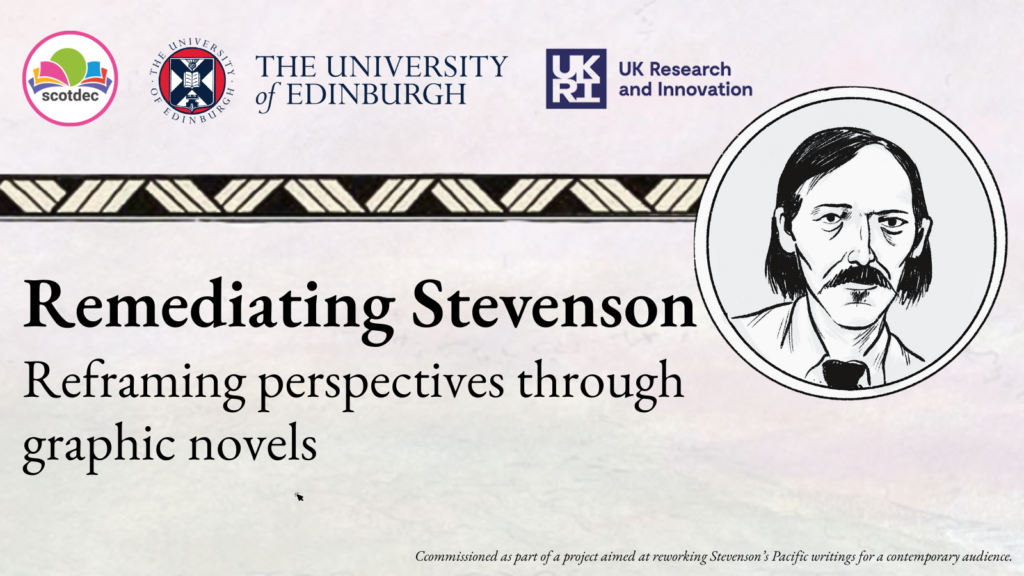
The Remediating Stevenson project reimagines the later works of Robert Louis Stevenson, the Edinburgh-born author best known for Treasure Island and Dr Jekyll and Mr Hyde. In his final years, Stevenson lived in Sāmoa, where he wrote stories that challenged colonial attitudes and placed Pacific Islander characters — including intelligent, resourceful women — at the centre of his narratives. His writing from this period offers a fresh and often overlooked perspective that can help learners reflect on issues of power, identity, and representation.
Developed in partnership between Scotdec and the University of Edinburgh, the resources bring together artists and poets from Scotland, Hawai‘i, and Sāmoa who have created new graphic adaptations and poetry inspired by Stevenson’s Pacific works. The resulting resources were designed with input from Scottish teachers to ensure they align closely with the Curriculum for Excellence, particularly within Literacy, Expressive Arts, and Social Studies.
Teachers can use the materials to explore narrative and perspective in English or Literacy, comparing Stevenson’s original stories with contemporary interpretations. They open up opportunities for meaningful discussion about representation and voice, encouraging young people to question how different cultures are portrayed in literature and why that matters. In Art and Design, the adaptations can be used as a springboard for creative visual storytelling, inspiring pupils to produce their own artistic responses. The resources also lend themselves to Social Studies, supporting exploration of Scotland’s historical and global connections, empire and intercultural understanding.
Each resource aligns with Education Scotland’s Anti-Racist Principles and offers an accessible way to begin decolonising the curriculum. Through these stories, learners can think critically about whose perspectives are shared and valued, and how literature can both reflect and challenge power structures.
The full set of resources is available via Scotdec, and includes Casting Shadows (CfE Level 4), The Isle of Voices (CfE Level 3), and The Bottle Imp (CfE Level 2). Together they offer creative, cross-curricular ways to connect Scottish literature with global stories — helping young people reflect on identity, fairness, and Scotland’s place in the wider world.
Explore the collection here.